

Custom-Made Glass Shower Enclosures in Odessa: Types, Prices, and How They Look in a Real-Life Setting
Julian Kaprishanskyi, who heads the glass structure division at OKNODOM, has a rule he brings to every initial client conversation: if someone sends a photo of a gorgeous catalog shower and asks to “recreate it exactly,” the first question is—did anyone actually measure your bathroom? Nine times out of ten, catalog dimensions simply won’t fit.
One of recent orders like this was an apartment on Nizhynska Street, where mirrors for the same space were custom-crafted alongside a shower enclosure. The client came to OKNODOM on a friend’s recommendation and later left a review on Google Maps: walls and doors made of toughened glass, hardware requested in a matte black finish, “turned out very stylish,” and both deadlines and budget were met. Another review on the company’s page highlights that same meticulousness and adherence to timelines, which is genuinely rare for glasswork: if there’s a sizing error, you can’t just rework something on-site—the glass is already tempered to exact specifications.
A similar case happened earlier in Lenposelok on Mohylivska Street, where an angular shower with swing doors was installed to fit an atypical bathroom geometry. That project was also detailed in the blog (in Russian), clearly illustrating that the approach taken on Nizhynska is a standard operating procedure rather than a one-off exception.
Why Glass Showers Are Increasingly Demanded in Odesa
Prefabricated acrylic or plastic cabins offer a quick fix, but they fail to integrate into non-standard bathrooms. Within Odesa’s housing stock—ranging from grand stalinkas to new developments with irregular bathroom layouts—standard floor plans are the exception rather than the rule. A glass partition is custom-built to match reality: specific angles, a designated podium, and exact ceiling heights. Furthermore, a frameless glass wall avoids visually slicing a small bathroom into cramped segments, keeping it part of a cohesive space.
The second factor is simpler—trends. Matte black hardware and sleek point-fixings instead of bulky profiles are currently requested far more often than classic white aluminum options.

Types of Glass Shower Structures
| Structure | Glass Thickness | Installation Specifics | Most Common Application |
|---|---|---|---|
| Stationary Partition (Single Wall) | 8–10 mm | Secured with connectors to the wall and/or podium, doorless | Combined bathrooms, bathtub perimeters |
| Swing Door + Partitions | 8 mm | Hinged door mounted to a side wall, pull handle | Dedicated shower zones, alcoves |
| Sliding System | 6–8 mm | Glass glides along upper/lower profile tracks | Restricted opening widths |
| Corner Cabin (Two Walls + Door) | 8 mm | Three glass panels connected at atypical angles | Bathroom corners, irregular layouts—like in Lenposelok |
For load-bearing elements, walls, and swing doors, 8 mm toughened glass is used. It offers sufficient rigidity to hold its shape without a frame, and upon impact, it shatters into small, blunt fragments rather than sharp shards like ordinary glass. Six-millimeter glass is used less frequently, typically for roller-sliding systems where loads are distributed differently.

Real-World Project: Swing-Door Shower on Nizhynska Street
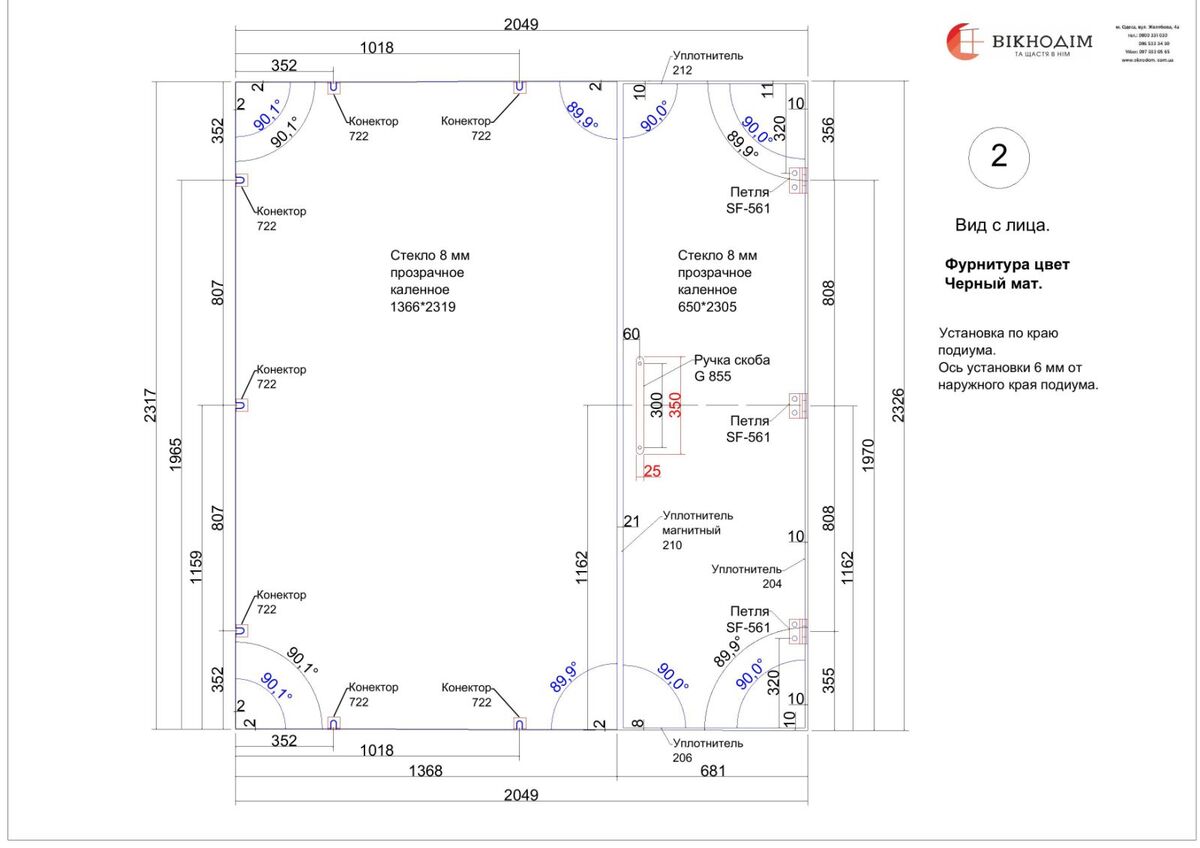
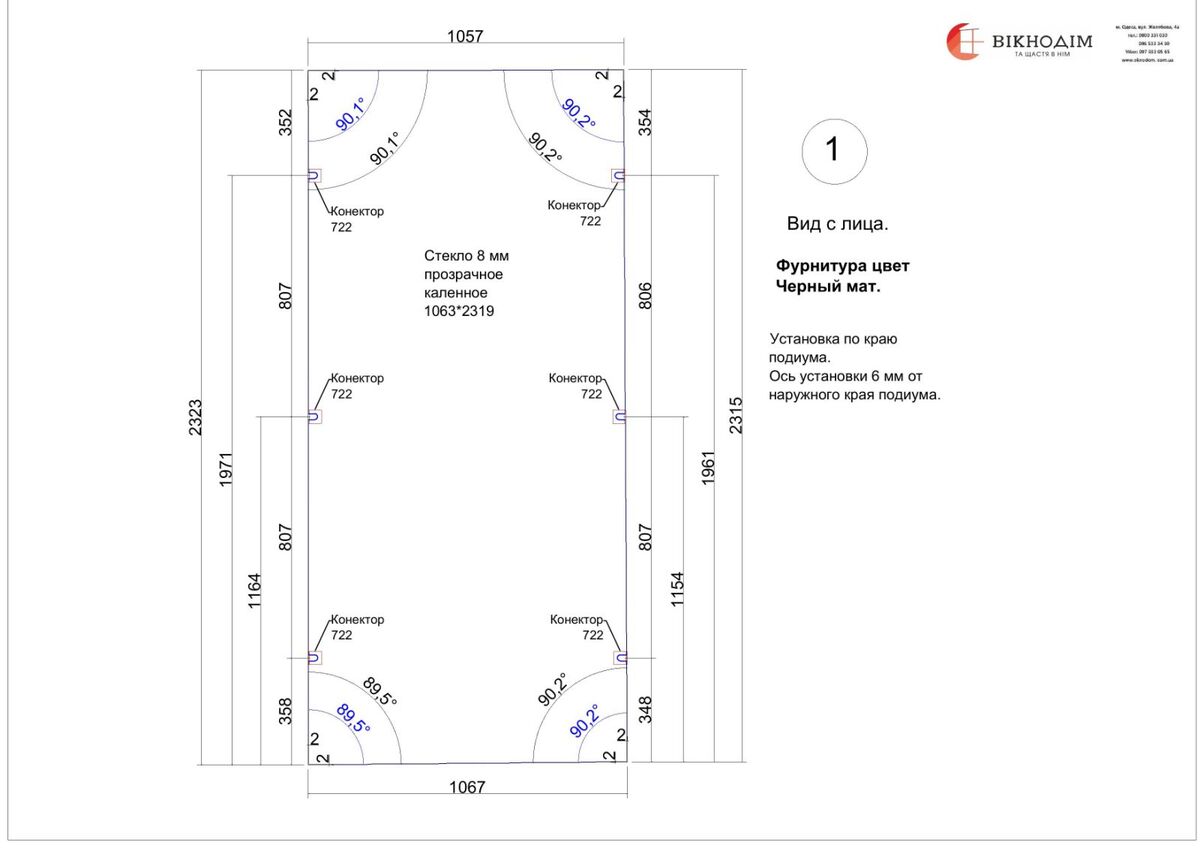
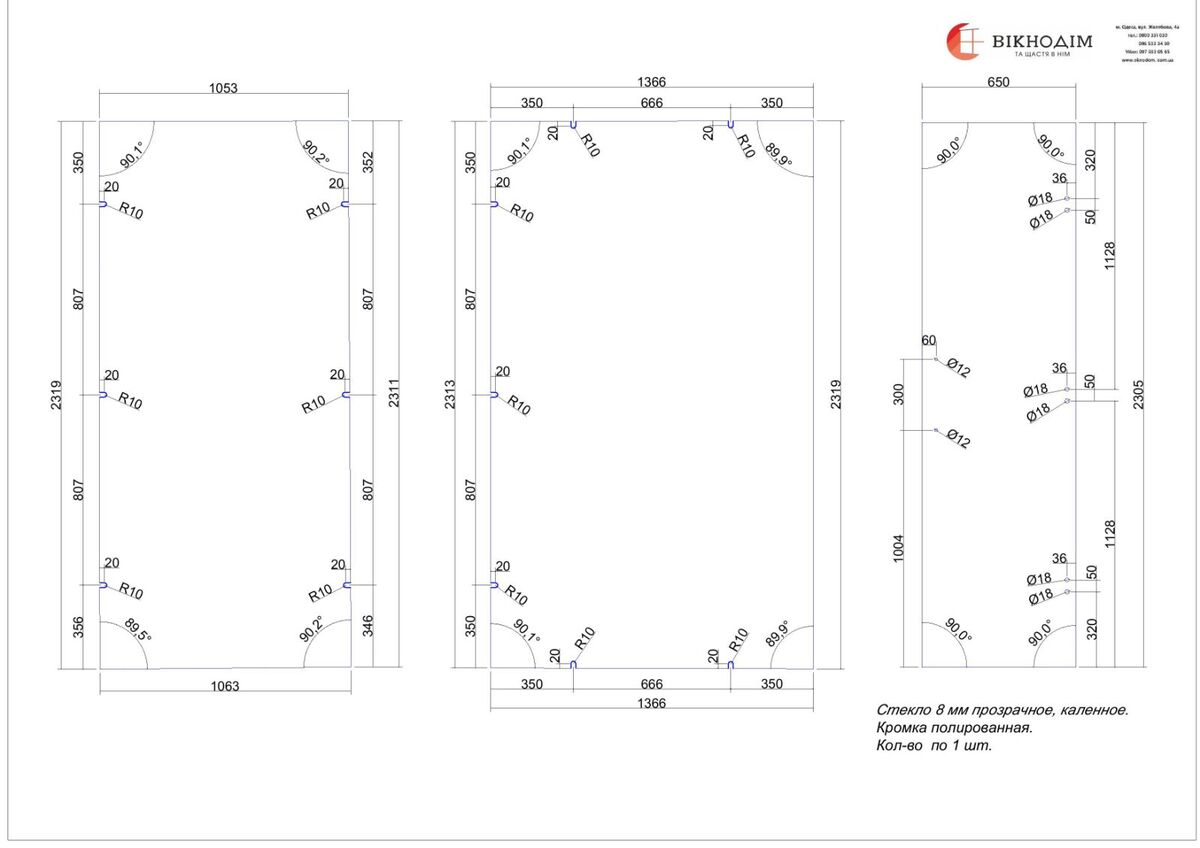
The installation blueprint reveals what “custom glass” entails in practice. It features three panels:
- side wall — 1063×2319 mm
- second side wall — 1366×2319 mm
- door — 650×2305 mm
All three are made of clear 8 mm toughened glass with polished edges and no framing.
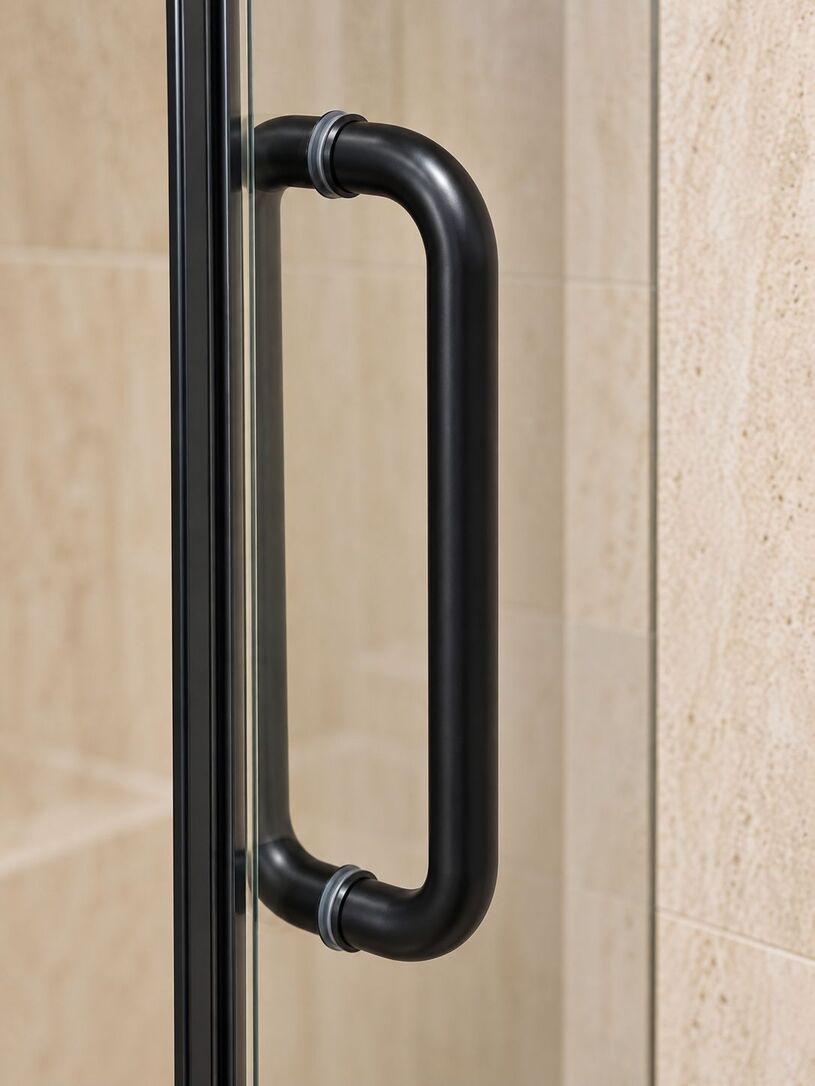
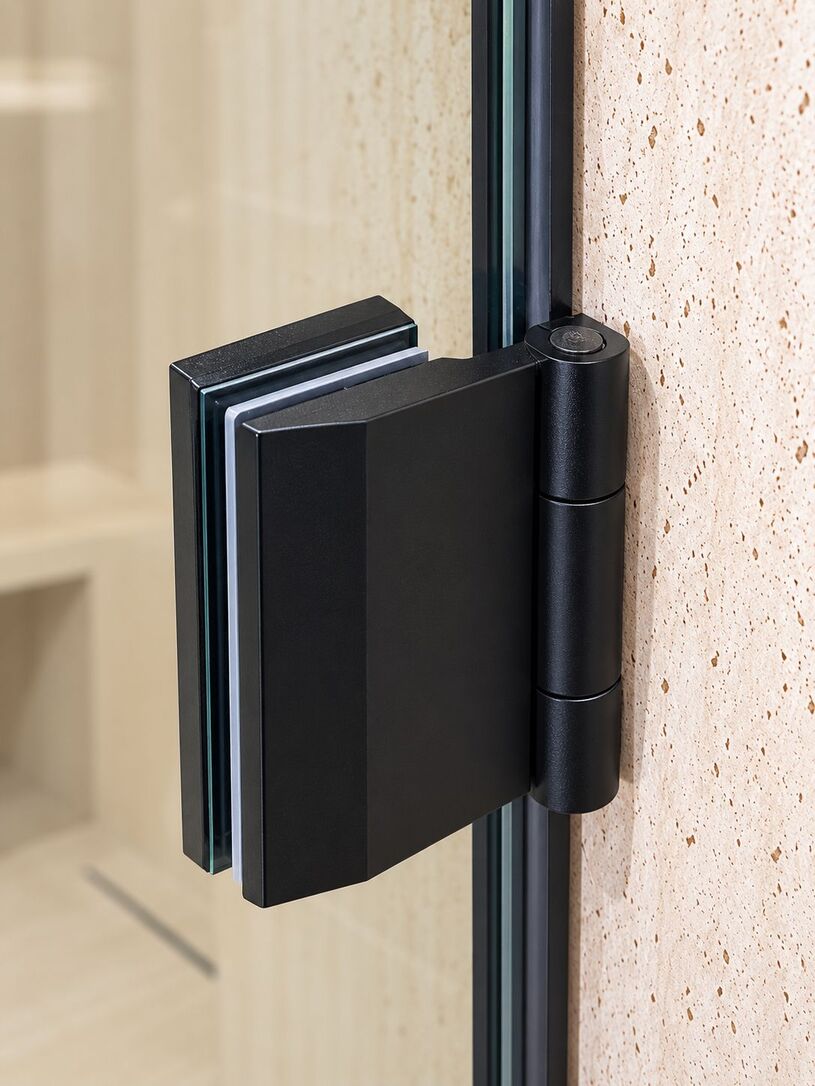
Mounting relies on 13 HDL-722 connectors: they secure the glass to the podium and join panels together instead of using a continuous profile. The door hangs on three SF-561 hinges with a G 855 pull handle. All hardware features a matte black finish, specified explicitly by the client rather than chosen as a standard catalog default.
Sealing is managed by four types of gaskets:
- HDL-204
- magnetic HDL-210 (which also keeps the door closed without a closer)
- HDL-206
- HDL-212 (800 mm each)
A silicone bumper runs along the bottom edge of the door to prevent glass-on-glass impact when closing.
Installation runs along the edge of the podium, with an installation axis set 6 mm inward from its outer edge. This is not an arbitrary number; it is a technical tolerance factored into blueprints beforehand to ensure the glass sits flush without being affected by screed unevenness.
«Eight millimeters and connectors instead of a profile aren’t about following trends,» says Julian Kaprishanskyi. «A profile forgives minor installation flaws by simply concealing them. With connectors, there’s nothing to hide—any angular deviation of even half a degree becomes immediately obvious. On Nizhynska, actual corner angles on the podium ranged from 89.5 to 90.2 degrees. Nothing critical, but every glass panel had to be cut to match its specific angle rather than an averaged right angle.»

How Glass and Hardware Are Chosen
Thickness isn’t the only parameter. Edges are always ground and polished prior to installation: an unfinished edge is prone to chipping over time from thermal fluctuations or accidental knocks, and toughened glass cannot be re-polished on-site—the panel would have to be replaced entirely. Fastener type is equally important: connectors deliver a lightweight, virtually weightless look but demand precise measurements because they hide zero errors. Profiles look visually heavier, yet they forgive minor dimensional discrepancies.
Julian recalls a typical instance: a client sent a screenshot from a third-party website stating “6 mm thickness for any door” and insisted on that option because it was cheaper. On-site, it turned out the client’s door was nearly 800 mm wide and opened multiple times a day; with 6 mm glass, such a door begins to flex over time, hinges loosen faster, and within a year or two, the hardware requires re-tightening or replacement. For doors wider than 600 mm, OKNODOM defaults to 8 mm precisely for this reason, rather than commercial upsell motives.
Privacy is another separate consideration. Clear glass preserves visual volume in compact bathrooms, but not everyone feels comfortable with a fully exposed shower zone. An alternative is satinizing (sandblasted frosting), applied either entirely or as a body-level frosted strip with clear top and bottom sections. This decision must be made during measurements, not after the glass has already been ordered and cut to size.
Measurement and Installation Process
Measuring for a glass shower isn’t a casual tape-measure job—it involves mapping out every angle and height while recording deviations in degrees, as demonstrated in the example above. Based on these measurements, an installation blueprint is drafted showing exact dimensions for each glass panel and the coordinates of fixing points. The glass itself is cut and tempered specifically for the project; ready-made standard panel warehouses for atypical dimensions do not exist, meaning production and delivery typically take one to two weeks depending on factory workload.
One crucial detail often overlooked during remodeling: measurements for a shower are taken only after the podium is finished and tiled, rather than relying on architectural blueprints. Ordering glass earlier runs the risk of delivering a finished enclosure that won’t fit snugly against tiled surfaces without gaps.
Installation takes a single day: panels are positioned on the podium, connectors are aligned according to blueprint specifications, doors are hung on hinges, and perimeter gaskets are applied. The structure is ready for use immediately following assembly.
Caring for a Glass Shower Enclosure
Toughened glass is unaffected by water, but mineral deposits from Odesa’s tap water show up more noticeably than on matte surfaces. Wiping it dry after every use isn’t strictly mandatory, but it’s the habit that keeps glass streak-free and transparent for the longest period. Existing buildup can be cleaned using acidic glass and plumbing cleaners; abrasive sponges are strictly forbidden as they scratch polished surfaces, and restoring the shine afterward is impossible.
Gaskets and magnetic door profiles should be inspected for elasticity every few months, especially on doors subjected to heavy traffic. Matte black connectors require cleaning agents suitable for specialty coatings without chlorine, which can lighten painted edges over time.

Related Services
If the goal is not a complete cabin but a standalone partition without a door to isolate the shower zone from the rest of the bathroom, OKNODOM offers toughened glass partitions, suitable for both bathrooms and other interior spaces. Ready-made solutions tailored specifically for shower cabins and their components can be found on the OKNODOM shower cabins page. A broader overview of glass partitions is currently available in Russian.
If custom glass cutting is required separately from a full build—such as replacing a cracked panel—detailed information on cutting and edge processing is likewise available in Russian.
Frequently Asked Questions
How much does a custom glass shower cabin cost in Odesa?
It depends on glazing area, structural type (partition, swing system, or corner cabin), glass thickness, and hardware color, as matte black is pricier than standard chrome. A similar corner project in Lenposelok cost 33,000 UAH turnkey, including measurements, manufacturing, delivery, and installation; exact pricing for your bathroom is determined via a free measurement.
Is toughened glass safer for showers?
Yes, shower cabins exclusively use 6–10 mm toughened glass. When shattered by impact, it disintegrates into small, blunt fragments rather than large, sharp shards like ordinary glass.
How long does it take to manufacture a custom shower cabin?
From measurement to installation usually takes one to two weeks, as glass is cut and tempered to project-specific dimensions. Installation itself takes a single day.
Can a glass shower be installed in a bathroom with uneven walls?
Yes, this is a standard requirement for custom glass. Actual angles—such as 89.5–90.2 degrees, as seen on Nizhynska—are recorded during measurements and used to custom-cut each individual glass panel.
How do connectors differ from aluminum profiles?
Connectors are point-fixings without a continuous frame, delivering a lighter visual look while requiring precise measurements since they don’t mask installation errors. Profiles look visually heavier yet forgive slight sizing discrepancies.
Conclusion
A custom glass shower cabin is a solution tailored to a specific bathroom rather than forcing a room to fit pre-made dimensions. Two real-world projects—on Nizhynska and in Lenposelok—demonstrate identical principles: precise angle surveying, 8 mm toughened glass with polished edges, hardware matching your preferred color palette, and millimeter-tolerance installation.
You can calculate costs and timelines for your bathroom following a free measurement by OKNODOM:
0800 331 030, 096 533 34 30, Viber 097 033 05 65.