

What’s Actually Inside a Vinyl Window Frame (And Why It Matters More Than the Price Tag)
Clients rarely ask about profile chambers or reinforcement thickness. They ask about the price and whether the window will withstand the winter. The answer to both questions lies in the frame section, not the color of the sash.
What determines profile quality
Number of chambers. In the series we work with, there are from 3 to 7. Each closed chamber is an air gap that slows down heat loss, so a profile with more chambers retains heat better under equal conditions.
Installation depth. In the simplest systems, it is 58–60 mm, while in premium ones, it is up to 82 mm. A deeper profile allows for a thicker glass unit and increases the energy efficiency class of the window as a whole.
Reinforcement. Galvanized steel at least 1.5 mm thick inside the chamber. Without it, the frame “wanders” over time due to temperature fluctuations, and on large sashes—balcony doors, panoramic glazing—this becomes noticeable after just a couple of seasons.
Sealing contours. Two or three around the perimeter of the frame and sash. A third contour is not for marketing, but for real protection against drafts during stormy sea winds, which are a daily occurrence in Odesa in the autumn.
Why identical-looking frames have different prices
Cost reduction usually occurs due to thinner reinforcement, fewer chambers, or profiles without zinc-calcium stabilizers. In a showroom, this is invisible. It becomes noticeable after one or two heating seasons: the frame freezes along the perimeter, the sash stops fitting tightly, and condensation appears on the slopes.
Profiles we work with at OKNODOM
- REHAU — up to 7 chambers, chosen for projects with high heat and sound insulation requirements.
- VEKA — a balance of price and characteristics, the most common choice for residential apartments.
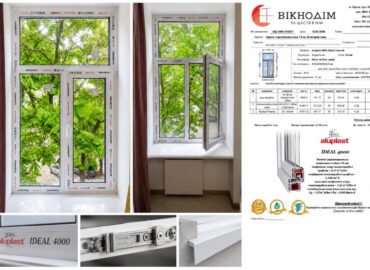
- ALUPLAST — 5–6 chambers, increased installation depth, holds panoramic glazing and wind loads well.
- GEALAN — German weld seam precision; we install this for facade solutions where frame geometry is important.
- KOMMERLING — one of the oldest PVC profile manufacturers in Europe; consistently high energy efficiency class according to our measurements.
- SALAMANDER — bluEvolution 82 series, 82 mm installation depth, six chambers, Uf 0.93–1.1 W/m²·K — a safety margin for Odesa’s fluctuations from -15°C in winter to +40°C in summer.
All listed profiles are produced without lead stabilizers — using zinc and calcium instead.
How much this saves
A properly selected frame with a double or triple-glazed unit reduces heat loss through the window opening by an average of 30–40% compared to old wooden frames. In practice, this means warmer windowsills in winter and lower heating bills — especially relevant for those currently restoring housing under the eVidnovlennya program who don’t want to overpay for heat again next year.
Still undecided — single-chamber or double-chamber glass unit to install in the frame? We have a separate analysis for the Odesa climate.
Installation matters just as much as the profile
Even a reliable frame will not provide results with careless installation — without vapor barrier, without foam across the entire width of the joint, and without hardware adjustment after the building settles. Our measurers visit the site before ordering rather than calculating based on photos in a messenger — this allows us to take into account the irregularities of window openings in the old housing stock of Odesa, Mykolaiv, and Kherson.
Once you have decided on a profile or want a calculation for your specific opening, submit a request via the calculator on our website.